Tuesday, November 30, 2021

Activity 4.2 Environmental Policy Frameworks


Davis, C.B., & Lewicki, R.J.,

2003

Bryan, T., 2003

Turning the world upside down: how frames of reference shape environmental law. (James Salzman and Martin Doyle, 2014)

Identity:

 The concept of identity

focuses on how individuals answer the question, “Who am I?”

Demographic:


Characteristics of a population like age, sex, religion, and gender.


Reference line Frames:


Law is considered binary. Your either in or out of the law in which it binds to. The government cannot force anything beyond the court.

Characterization:


Statements that are made by individuals on how they understand others to be.

Legal:


Consists of laws, regulations, legal procedures, and court decisions.


Fluid Dynamics:


How people get answers from differing issues that can differ from multiple ways to conduct several different studies that can be executed.

Conflict-management:


Focuses on how disputants’ preference for how the conflict management process should be managed.


Political: 


Characteristics of the political processes and institutions in a society, such as general form of government.


Fact-Finding:


How technical experts see and approach their roles in environmental disputes.

Economic:


Prosperity within an economy which range from inflation, interest rates, tax rates, and as well as labor, capital markets, and economic market.


Social Control Frames:


Represents on how an individual views about how decisions regarding social issues should be made.

Cultural:


Consists of the “predominant values, attitudes, beliefs, social customs, and socialization.


Power frames:


Explore the ways that individuals can gain power.


Risk-Frames:


Risks that are associated with environmental hazards or actions.


My Political Frame


Identity:

How an individual feels towards are certain issue because the demographic they may fall under like age, sex, race, gender, and religion. Identity helps answers the question “Who am I”

Fact Finding:

Research that is necessary to find all facts of the situation that can be presented in order to convince someone why an issue has importance.

Reference Line Framing:

A boundary that is set in where the government can operate in and is only allowed movement in which the courts give them.

Risk:

Every action that is take a risk assessment must be taken to identify potentials hazards or actions.

Political:

Where issues are brought to demand some type of change from the government.


Identity:

I believe identity is important because it gives an understanding why someone views things a certain way. Identity can be race, age, gender, religion, political affiliation, and sex. These categories are important when it comes to implications of environmental policy. Age and party affiliation is one of two factors that stick out to me because in today's world its crucial piece of identity that usually goes hand and hand with each other. 

Fact-Finding:

Fact-finding is an important frame that needs to be used because it helps create solid evidence that can be used to educate others. Fact-finding also replaces false information that was created to discredit something that is consider bias to stop a passing of an environmental policy.

Reference Line Framing:

Reference line framing is important because it places everyone within the law and the government can only enforce that law in were the courts set the boundaries of the law. This allows individuals to feel some since of security knowing that the government can only act within the law and not out of it.

Risk Framing:

Risk Framing shows us the risk that comes with certain laws and policies that may have an impact on the environment and economy. Risk should be associated with everything we do when it comes within the environment. No matter what happens something is going to be affected and all avenues must be looked at so that we know what course of actions is the best going forward.

Political Framing:

The last one I have is political framing because I believe most things are politically motivated regardless of the party someone falls under. Almost every environmental issue old or new was created through political means in which people were able to convince a certain demographic within the government to take action and demand change throw political means. 


Cited Work:

 Bryan, T. (2003). Context in environmental conflicts: Where you stand depends on where you sit. Environmental Practice, 5(3), 256-264.


Davis, C. B., & Lewicki, R. J. (2003). Environmental conflict resolution: Framing and intractability--an introduction. Environmental Practice, 5(3), 200-206.

Salzman, James, and Martin Doyle. "Turning the world upside down: how frames of reference shape environmental law." Environmental Law, vol. 44, no. 1, winter 2014, pp. 1+. Gale OneFile: Environmental Studies and Policy, link.gale.com/apps/doc/A366344743/PPES?u=txshracd2891&sid=bookmark-PPES&xid=0de4314d. Accessed 30 Nov. 2021

Thursday, November 11, 2021

Activity 4.1 - US Environmental History and Major Regulations

Throughout American history environmental policy has changed several times. The reason why we saw changes was on how we started to view the environment, and the impact that we created which led to the creation of laws and creation of departments within the government. American environmental policy can be broken up into three categories which were the American conservation movement, the rise of risk management as a basis for policy, and the integration of social and economic factors.

The start of American environmental policy started with the first European settlers that settled in the Americas in which the term wastage was used. Wastage refers to an action or process of losing or destroying something by using it carelessly or extravagantly. They didn’t take the environment into consideration because resources were abundant. If one tree was knocked down all they had to do was move to the next, if fisheries became impaired, they moved up stream, and had endless herds of wild animals to hunt. (Theis, T., & Tomkin, 2018) These attitudes persisted well into the 19th century, and still exist today. Even though there wasn’t much environmental policy during this time it allowed small groups to form which had people like Jared Elliot that notice some of these issues and helped with cultivating better field husbandry. (Theis, T., & Tomkin, 2018) 

By the early 1800's impacts of soil erosion and infertility, decreasing crop yields, and natural barriers of expansion from poor transportation and terrain led to organize an effort to understand the cause of these problems, and experiments that may help solve them. It was initially started to help with agriculture but later expanded into management of forest and timber, waste from mining and smelting, and the control of human diseases. (Theis, T., & Tomkin, 2018) There were many individuals that helped with these problems and to name a few were Eugene Hilgard, John Wesley Powell, George Perkins Marsh, and many more. These individuals helped solve the scientific reasons on why they were having these problems and were able to pinpoint them to our everyday behavior towards the environment. The departments that were created was the Department of the Interior, Agriculture, National Park Service, US Forest Service, and US Geological Service. (Theis, T., & Tomkin 2018)

By 1830’s a movement called transcendental movement in which led to some individuals to value their surroundings over conformity and unreflective habits of living. (Theis, T., & Tomkin, 2018) The leader of this movement was named Ralph Waldo Emerson in which he set the tone for how we should our relationship with the natural world. This movement wanted to show that all of us were one with nature and we are intertwined with it. During this period the camera wasn't established well enough to capture the beauty of nature so instead paintings were used show the beauty of nature. The transcendental movement died off around the middle of the 19th century but influenced people like John Muir. John Muir was a well know activist and lobbyist and served as a guide for President Roosevelt for the Yosemite Region. They both shared similar goals with conservation which helped Roosevelt create over 50 national parks. (Theis, T., & Tomkin, 2018) 

The industry’s role in American environmental policy has always been deemed hostile or indifferent. There are several reasons why industrial sector was portrayed like this. First there was little to no incentives to manage emission responsibly or use natural resources wisely. (Theis, T., & Tomkin 2018) Second there was few regulations that stopped industrial harming the environment and was looked like the necessary benefit of expansion and growth. This makes industries sensitive to economic conditions because it was the engines for employment and controlled large portions of capital investments. (Theis, T., & Tomkin, 2018) Industries played important roles in which they helped create a middle class, creation of wealth, the easy availability of goods and services which allowed Industries to get away with misuse and damages to the environment. Industries also helped with the creation of many conservation projects because they created a destruction of the environment, and which finally started to catch the eye of the public and government.

With great strides in conservation several events occurred like both world wars in American history where we saw the decline of conservation. After World War II most attention was focused on restoring rather than focusing on environmental issues. This shows the public and government perspective of environmental issues vs economic issues. From 1948-1978 several incidents were recorded which shows the effects of environmental issues from the public. One incident was the Zinc smelter in a small Pennsylvania town in which emissions were uncontrolled in which caused emissions to being trapped which created horrible air conditions that resulted in about 50 recorded deaths. (Theis, T., & Tomkin 2018) During this period, it was looked as being widely acceptable to having poor air conditions for living in industrial society. Air quality was the only culprit of creating hazards, and contamination. Waterways and burial of hazardous materials were also a source for this. Some historic incidents of these were the Cuyahoga River Fire which was the result of heavy pollutants which caused the river to catch on fire. The other one was the finding of the burial of hazardous materials in a neighborhood in Niagara Falls, New York. (Theis, T., & Tomkin 2018)

 After reading basic information on US environmental history you can't help sit and wonder why it seemed that it took so long to enact laws protecting the environment. If we focused early on with environmental issues we could've have made great strides in health of not just ourselves but the environment. Issues like the Cuyahoga River could of been prevented. Its also disheartening to see that we usually only make laws to protect parts of the environment after disasters have happened. 


Major Environmental Policy In the US

Cited Work: 

Russell, E., & Fairfax, S. K. (2014). Guide to U.S. Environmental Policy (Links to an external site.). CQ Press. Chapter 28, see specifically pp. 400 - 407.

Theis, T., & Tomkin, J. (Eds). (2018). Sustainability: A comprehensive foundation. OpenStax CNX.


Thursday, November 4, 2021

Activity 3.3.3 Plastic Waste (Microplastic)

Microplastics are plastics that are five millimeters in size or smaller. They are no bigger than a single grain of rice. There are two types of microplastics. The first one is considered a primary plastic because they were engineered to be small and are used for medical, industrial, and personal purposes. Secondary microplastics are the breakdown of plastics that come from larger plastics like bags bottles, netting, and rope. (Barrow, 2019) They can be hard to detect, and you would need a microscope to see most of them. They can be found in our oceans, rivers, lakes, and streams. Once they make into our waterways they can be found in the guts of fish, and other aquatic life.

Microplastics can get in our waterways from several different ways. This includes trash entering our seas from boats at sea, trash that gets into the ocean from beaches, and trash  from rivers that feed into the ocean. Microplastics can also be found in most cosmetics which will travel down drains from sinks and enter through our sewage systems which will eventually be treated and reentered into our waterways. The problem is that most of our filters cannot filter out most of the microplastics. Once the plastics enter the ocean the currents then pull plastic into one of the great garbage patches. The sun will then break them down into smaller and smaller plastics which they will eventually shrink in size to become microplastics. We have six great garbage patches with five of them being in the sub-tropics and one being in the Artic in the Bering Sea. In the great garbage patch in Pacific there is more weight in plastic then aquatic life. (Sebille, 2013)

Microplastics can be harmful to aquatic life because they can block digestive tracts, diminish the urge to eat, altering feeding behavior, reduce growth, and disrupt reproduction. (Rotye) Microplastic can also absorb chemicals from runoff that enters our waterways. Plankton can then grow on the plastic in which fish will eat. Birds will then eat the fish passing on the microplastics and any chemicals through the food change. Some of these chemicals are polychlorinated biph (PCBs), polycycle aromatic hydrocarbons (PAHs), and heavy metals. Another potential harm that can come from microplastics are microbeads that are found in cosmetics. Phthalates are a group of chemicals that can be found in hundreds of cosmetics like nail polish and hairspray. (Plastic Soup Foundation) This is a chemical that could cause cancer because they react as an endocrine disruptor. So far 15 countries have banned or will ban microbeads which includes the United States, and Canada. 

There are several things we can do to slow down creation of microplastics from increasing and from entering our waterways. First, we can refuse using plastics like water bottles, bags, and any other plastic that can’t not be reused. Instead, we should go after more environmentally friendly items like biodegradable bags that can be found at most of our grocery stores or refillable water bottles like Yeti or RTIC that can be reused numerous amounts of times. This will help reduce the amount of plastic being used. Lastly, we can recycle plastics which will help plastics to be reused. We can also pressure more countries into banning microbeads that are found in cosmetics. I believe we all must be actively engaged to reduce the amount of microplastics.


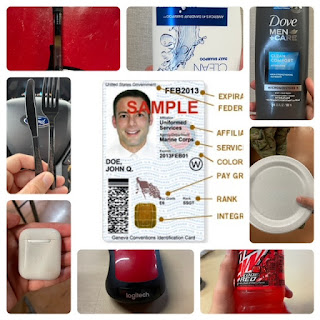
This is my photo collage with items I use just about everyday ranging from showering, eating, and technology. I included a photo example of a common access card from the military. I just didn't want to take a picture of mine because there is sensitive information on the front and back. 

Cited Work:

Simons Foundation Science Sandbox (Producer). (2019). World class explorers help scientists collect elusive data [Video]. Retrieved from

https://youtu.be/AYNmwJlGnC4

Van Sebille, E. (2013). Charting the garbage patches of the seas [video]. University of New South Wales. Retrieved from

https://youtu.be/M4UK9Yt6A-s

International Campaign Against Plastic in Cosmetics. Beat the Microbead. (2021, May 18). Retrieved November 4, 2021, from https://www.beatthemicrobead.org/.

Dudas, S. (2018). Microplastics are everywhere [Video]. TEDx Binghampton University.Microplastics are everywhere | Sarah Dudas | TEDxBinghamtonUniversity

Tuesday, October 26, 2021

Activity 3.3.1: Air Pollution Core Activity

Air Pollutants:

Sulfur - Sulfur dioxide (SO2) and Hydrogen sulphide (H2S) are two of the most important sulfur gases in air pollutants. Both gases can be distinguished by taste or smell. Sulfur dioxide has a bitter taste, and hydrogen sulphide has a rotten egg odor. SO2 and H2S can be naturally produced through volcanoes and forest fires. Human activity can also contribute to the making of anthropogenic emissions of SO2 and H2S through the burning of fossil fuels. Anthropogenic emissions have been on the rise since 1860 with the start of the Industrial revolution. (Freedman, 2018) Vegetation, and humans around places of high sulfur concentration can be affected but rarely are. Most developed nations have put in measures to reduce sulfur gases from entering the air. We can place scrubbers within industrial plants, and wash the coal to get as much of the sulfur out. 

Nitrogen - With nitrogen gases the most important ones are nitric oxide (NO), nitrogen dioxide (NO2), nitrous oxide (N2O), and ammonia (NH3). Ammonia is a colorless gas. Nitrous oxide is a colorless non-toxic gas that has a euphoria feeling when inhaled. This gas is commonly referred to as laughing gas. Nitric oxide is a colorless and odorless gas. Nitrogen dioxide is a reddish pungent gas that can cause irritation in respiratory, and eye membranes. Ammonia is created by decaying remains of dead biomass but with the human activity the burning of fossil fuels release ammonia into the air. The damage that nitrogen can cause is the photochemical reaction that produces ozone which is a harmful pollutant in the lower atmosphere (Freedman, 2018)

Hydrogen Carbon, and VOC's - Hydrocarbons are diverse group of chemicals that is a combination of hydrogen or Carbon. Methane (CH4) is naturally occurring for the most part from animals such as sheep and cattle. Termites can also produce methane from digesting their plant foods (Freedman,2018). Methane can also be released from fossil fuels and wildfires which gets absorbed into the atmosphere. Atmospheric Hydrocarbons are considered non-methane hydrocarbons. They mostly come from living vegetation like a forest during a warm sunny day. Methane (CH4) is a greenhouse gas that contributes to global warming and the creation of ozone in the lower atmosphere which is harmful. 

Air Quality Index - AQI is used to measure air quality and can tell us how clean or polluted the air is. It measures the air for sulfur dioxide, carbon monoxide, ground level ozone, and any other particle pollution. The scale used ranges from 0-500 using the terms good, moderate, unhealthy for sensitive groups, unhealthy, very unhealthy, and hazardous. 


Time of Day

AQI Current

AQI Forecast

PM2.5

O3

Portola, California

5:00 am

101

Good

101

 N/A

New Braunfels, TX (Where I Live)

7:00 am

30

Good

30

14

Los Angeles, CA

5:00 am

53

Good

53

6

The chart above shows Portola California being the worst for air quality at that specific time. The information for O3 or the forecast was not immediately available for Portola California. New Braunfels is currently at 30 PM 2.5 and Los Angeles at 53 for PM 2.5. O3 is low for both cities as well with New Braunfels 14 and Los Angeles at 6.

PM-2.5 - is an air pollutant that can be measured to determine air quality. PM-2.5 are tiny particles and water droplets. The measuring of PM-2.5 can also warn people to stay indoors if they are sensitive to poor air quality. 

Ozone - There are two levels in which ozone can reside in with it being in the stratosphere and troposphere which is ground level. Ozone in the ground level is the most damaging because it can cause respiratory illnesses, damaging of eyes, and a loss of lung function in humans and animals. 

National Standard

San Antonio Current measured over 1 hour

Time of Day

PM2.5

Average measured over 24 hours - 35 μg/m3

12.0 µg/m3

8:00 am

O3

Average measured over 8 hours - 70 ppb (137 µg/m3)

11 ppb

8:00 am

Source: Texas Commission on Environmental Quality

Sources: 

Freedman, B. (2018). Environmental science: A Canadian perspective. Halifax, Canada: Dalhousie University Libraries.

US Environmental Protection Agency (EPA). (2019, June 18).Air quality index basics. Air Now. https://airnow.gov/index.cfm?action=aqibasics.aqi

Texas Commission on Environmental Quality. Go to TCEQ Web Page. (n.d.). Retrieved October 27, 2021, from https://www.tceq.texas.gov/cgi-bin/compliance/monops/select_curlev.pl?user_param=88502.

Texas Commission on Environmental Quality. Go to TCEQ Web Page. (n.d.). Retrieved October 27, 2021, from https://www.tceq.texas.gov/cgi-bin/compliance/monops/select_curlev.pl.


Tuesday, October 19, 2021

Activity 3.2.3 – Alternative Energy: Wind Energy


Credit: Ph.wittaya, Shutterstock.com

Alternate Energy - Alternate energy is another name for renewable energy. Alternate energy is solar, wind, hydropower, and biomass because it can regenerate quickly. Alternate energy are resources that industrialized countries usually don't rely on but instead use fossil fuels. 

Arguments for Alternate Energy: 

There are several reasons for using alternate energy. The first reason is it allows us to stop relying on fossil fuels because fossil fuels are non-renewable resource and once they are used up, they are no longer available. Most renewable energy creates zero greenhouse emissions.  Another reason to get into more alternate energy is to become less energy dependent on other nations and could boost the economy by created more jobs through manufacturing, and installations. I believe wind should be the most sought out renewable resource because you can put them just about anywhere. Wind is a renewable resource that uses wind to generate electricity 

Advantages of Wind Turbines

Wind Turbines do not create air or water pollution and has no need for water to cool anything down. Since wind turbines are relatively small regarding their footprint and they tend to be placed on crop fields, ranches pastures, forest, and coastal areas. They also bring in an extra income for farmers and ranchers, which allows the farmers, and ranchers to keep their land from being poached for commercial use. You can also place them in remote places along the Appalachian Mountains instead of using mountain top removal to extract coal for energy in where rich biodiversity is destroyed, water is contaminated, and creates a good amount of air pollution.  

Disadvantages of Wind Turbines

There are several disadvantages when it comes to wind turbines. First there is a considerable amount of noise pollution for animals, and humans that live near them. Wind turbines have also killed birds and bats if the wind turbines are in their migratory path. Some wind turbines have caught on fire, and some of them have leaked lubricants into the environment but is considered to be rare. 

Cited Work: 

Mutiti, S., Mutiti, C., Manoylov, K., VandeVoort, A., & Bennett, D. (2018). Introduction to environmental science (3rd ed.). Biological Science Open Textbooks. University System of Georgia.

Environmental Protection Agency. (n.d.). EPA. Retrieved October 20, 2021, from https://www.epa.gov/statelocalenergy/local-renewable-energy-benefits-and-resources.

Energy, G. D. (n.d.). Biggest influencers in wind power in Q3 2020: The top individuals to follow. Power Technology. Retrieved October 20, 2021, from https://www.power-technology.com/features/biggest-influencers-wind-power/.

Thursday, September 30, 2021

Activity 3.2.1 - Natural Resources Review


In the concept map above I have it Illustrating the two types of resources we use for energy. The two types of energy we have are nonrenewable, and renewable. Nonrenewable resources are resources that comes from the earth but takes a long time for it to regenerate which cannot keep the pace of the number of resources being exhausted. These nonrenewable resources are coal, natural gas, crude oil, and nuclear. Fossil fuels are the decayed remains of plants and animals over millions of years. We simply don’t have the time to wait for fossil fuels to be replaced. Uranium used in nuclear power is also not a renewable resource. If we use too much it can become scarce or completely exhausted.

Renewable resources are resources that are abundant, and we will not have to worry about exhausting through them and can regenerate fast. Renewable energy has been gaining a lot of steam in the last decade especially with the contributing factors that fossil fuels have on the environment. The pollution of fossil fuels is being linked to climate change. The renewable resources we have is solar, wind, hydropower, biomass, and geothermal. The biggest downside to renewable energy is being expensive but with Evolving technologies can help reduce the expense of renewable energy. Solar is the easiest renewable energy to obtain because the sun shines on most of the earth on any given day

Cited Work

Jerome, B. A. (Producer). (2017). Exploring Natural Resources [Video file]. Visual Learning Systems. Retrieved from https://nvcproxy.alamo.edu/login?url=https://video.alexanderstreet.com/watch/energy-3 (Links to an external site.) 

Thursday, September 23, 2021

Activity 3.1: Human Population.

Country: France    
Birth Rate: 11 per 1,000
Death Rate: 10 per 1,000
Population growth rate (rate of natural increase) 0.1%
Life Expectancy for males and females: M(79) F(85)
Fertility Rate: 3.4
Gross National Income (GNI): 50,400


France is a developed country that has a population of 65.3 million. France lies in Western Europe and is part of the European Union and NATO. France is considered a major Economic power. France has a mixed economy that's mixed with a little bit of private freedom, centralized economics planning, and government regulations. France is border by Belgium, Germany, Spain, Italy, Switzerland, Atlantic Ocean, English Channel, and the Mediterranean Sea

Country: Somalia       
Birth Rate: 49 per 1,000
Death Rate: 11 per 1,000
Population growth rate (rate of natural increase) 3.8%
Life Expectancy for males and females: M(56) F(60)
Gross National Income (GNI): 870


Somalia is considered a least developed country with a population of 16.4 million. Somalia is part of the Horn of Africa that is bordered by Djibouti, Kenya, Ethiopia, Gulf of Yemen and the Indian Ocean. Somalia has a traditional economic with most of the populace engaging in the selling of livestock, and agriculture. Somalia is also a member of the League of Arab States. 


Country: World    
Birth Rate: 18 per 1,000
Death Rate: 8 per 1,000
Population growth rate (rate of natural increase) 1.0 %
Life Expectancy for males and females: M(71) F(75)
Gross National Income (GNI): 17,535

Comparison:

When comparing these two nations you see a huge separation in a lot of demographics. The obvious cause for this big separation is due to France being a developed nation, and Somalia being a least developed nation. Both countries have almost an equal death rate, but Somalia has a higher birth rate being 49 per 1,000. France has a smaller birth rate sitting at 11 per 1,000. The reason for France having a low birth rate is due to being in a postindustrial era where the quality of living is better, and families no longer need to have huge families in order to survive. A big reason why developed countries will tend to have a low birth and death rate are due to the access of resources that are readily available to them like having better healthcare that can provide vaccines to fight major illnesses, better sewage treatment, nutrition, and education that allows people to focus on careers. The Gross National Income in France is higher compared to Somalia and the world. France has a GNI of 50,400, Somalia's GNI stands at 870, and the world at 17,535. Somalia on the other hand being a least developed country makes it hard for its citizens to have access to all things that are available that French citizens have access to. Somalia and least developed nations must worry more about major illnesses like yellow fever and malaria. Without adequate healthcare in Somalia and in less developed countries they are at a continued risk of dying from major illnesses. Life expectancy for France is high sitting at 79 years for males, 85 years for females. Somalia is sitting lower than France and the world at 56 years for males, and 60 years for females. The world is sitting at 71 years for males and 75 years for females. France has a higher percentage of an urban population than Somalia, and the world. France sits at 81 %, Somalia at 46 %, and the world at 56%. One of the main reasons for France having a high urban population is the availability that urban areas bring like jobs, healthcare, and education. These two countries are clearly on the opposite side of the spectrum with France having a stable population, and Somalia with conditions improving slightly but not enough to pull them out of a preindustrial stage. 


Cited Work: 

Population Reference Bureau. (2021). 2021 world population data sheet. 2021-World-Pop Data-Sheet.pdf

Blondel, Jean F.P. , Bisson, T.N. , Elkins, Thomas Henry , Wright, Gordon , Weber, Eugen , Popkin, Jeremy David , Bachrach, Bernard S. , Woloch, Isser , Higonnet, Patrice Louis-René , Drinkwater, John Frederick , Tuppen, John N. , Shennan, J.H. , Flower, John E. , Fournier, Gabriel and Bernard, François. "France". Encyclopedia Britannica, 22 Sep. 2021, https://www.britannica.com/place/France. Accessed 23 September 2021.

Somalia: Introduction. >> globalEDGE: Your source for Global Business Knowledge. (n.d.). Retrieved September 24, 2021, from https://globaledge.msu.edu/countries/somalia#.


Smith, Whitney. "Flag of Somalia". Encyclopedia Britannica, 13 Nov. 2018, https://www.britannica.com/topic/flag-of-Somalia. Accessed 23 September 2021.

Activity 5.1 - 8 Ways We Can Change the World.

  How to save our planet. Biological People are having less children. With the help of education, women rights, and rai...